
You work in the transportation industry, where workplace drug testing is part of the job. It doesn’t happen every week, but it happens often enough.
But not today, hopefully. It’s early on a Saturday morning and you arrive for your shift after a night out with mates. You took an eccy pill, also known as MDMA, so when you arrive for your shift and see testers set up near the site office, your stomach drops.
Will the MDMA be detected?
The honest answer is we do not know. But it is very possible.
But here is where things become more complex.
Even if a substance is detected during screening, you will not immediately receive a confirmed positive result. You will not automatically lose your job. And you will not face instant disciplinary action on the spot.
What you are lining up for is a screening test. If MDMA is detected at this stage, the result will be recorded as a non-negative result — not a confirmed positive.
Confused?
To understand what could happen next, it helps to know how workplace drug testing works. It also helps to understand the difference between screening and confirmatory testing. Because in workplace drug testing, the first result is not the final result.
A positive screening result is not the final result
One of the biggest misunderstandings about workplace drug testing is the belief that an on-site result is final.
It is not.
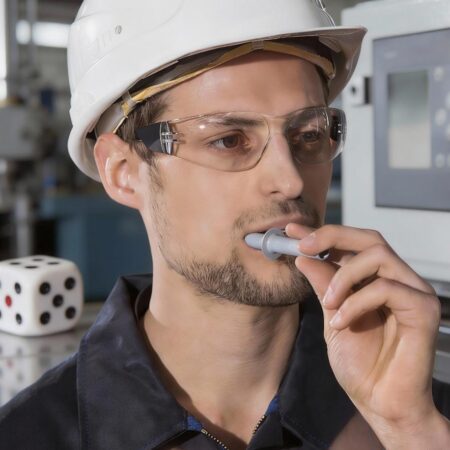
On-site drug testing provides a screening result only. It identifies whether a substance may be present above a set cut-off level. If a substance is detected, the result is recorded as non-negative.
Non-negative does not mean confirmed positive.
When a non-negative result occurs, another sample is securely sent to an accredited laboratory for confirmatory testing. Laboratory testing uses highly sensitive and specific methods to accurately identify substances and measure levels.
This step protects everyone. It protects the employer from acting on an incorrect result. It protects the employee from unfair disciplinary action. It ensures the workplace drug testing program is defensible under Australian workplace laws.
Screening identifies. Confirmation proves. Only after confirmatory testing can a result be formally classified as positive.
Whether you fail depends on several factors
Now return to the question running through your mind in that Saturday morning queue. Will the MDMA be detected?
Detection depends on several variables.
These include:
- The type of drug taken
- The quantity and purity
- When it was taken
- Your metabolism and general health
- The workplace drug testing method used, particularly, whether it’s urine or saliva
Saliva testing detects recent drug use. Urine testing has a longer detection window and may detect past use that does not relate to current impairment.
As a general guide:
- Cannabis may be detected for up to 24 hours in saliva, but up to 30 days in urine in some cases.
- Amphetamines and methamphetamines are usually detectable for up to 24 hours in saliva and up to four days in urine.
- Heroin and cocaine can be detected for up to two days in saliva and around three days in urine.
- MDMA detection windows are similar to amphetamine-type substances, although individual factors can change the timeframe.
This means that if you took MDMA last night, it’s highly likely it will be detected during workplace drug testing the next morning.
What are the chances of a non-negative screening result coming back as a negative during laboratory testing?
Hypothetically, let’s say you fail the workplace drug testing for MDMA. How likely is it that the confirmation testing will come back as a negative?
Again, the answer is, it depends.
If the workplace drug testing is completed using some screening swabs, there is a chance you may be okay. However, if the testing is being carried out by Integrity Sampling, you better start worrying.
For our drug screening, Integrity Sampling uses Dräger drug testing devices — leading devices in rapid drug detection technology. Both offer over 99% accuracy according to independent evaluations. So when we record a non-negative on a worksite, the vast majority of times the laboratory result will come back as a positive.
What happens next is what matters most
Let us return to that Saturday morning scenario.
You are still standing in line. You provide a saliva sample. The device indicates a non-negative result. But that doesn’t mean you face consequences for now. You have not lost your job. Because a laboratory needs to confirm the result.
If laboratory confirmation detects MDMA above the required threshold, your employer’s policy will determine the next step. That may involve disciplinary action. It may involve education and monitoring. It may involve termination in high-risk environments.
But, importantly, all this has to wait until the confirmation testing is known. Because when it comes to workplace drug testing, what happens next is what truly counts.
FEATURED IMAGE CAPTION:
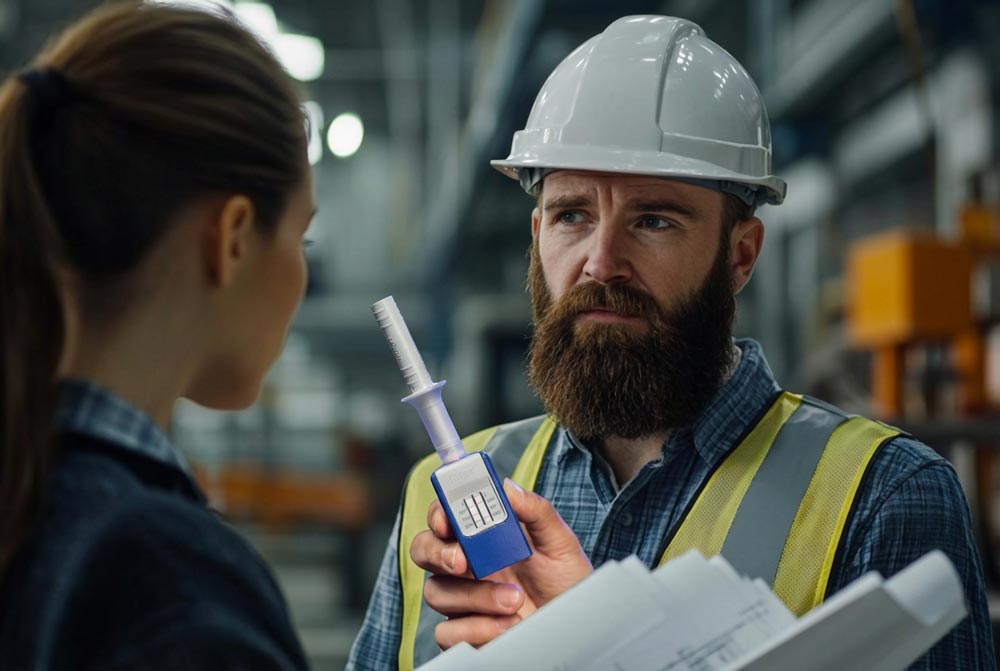
A supervisor explains the workplace drug testing process to an employee after non-negative result.