

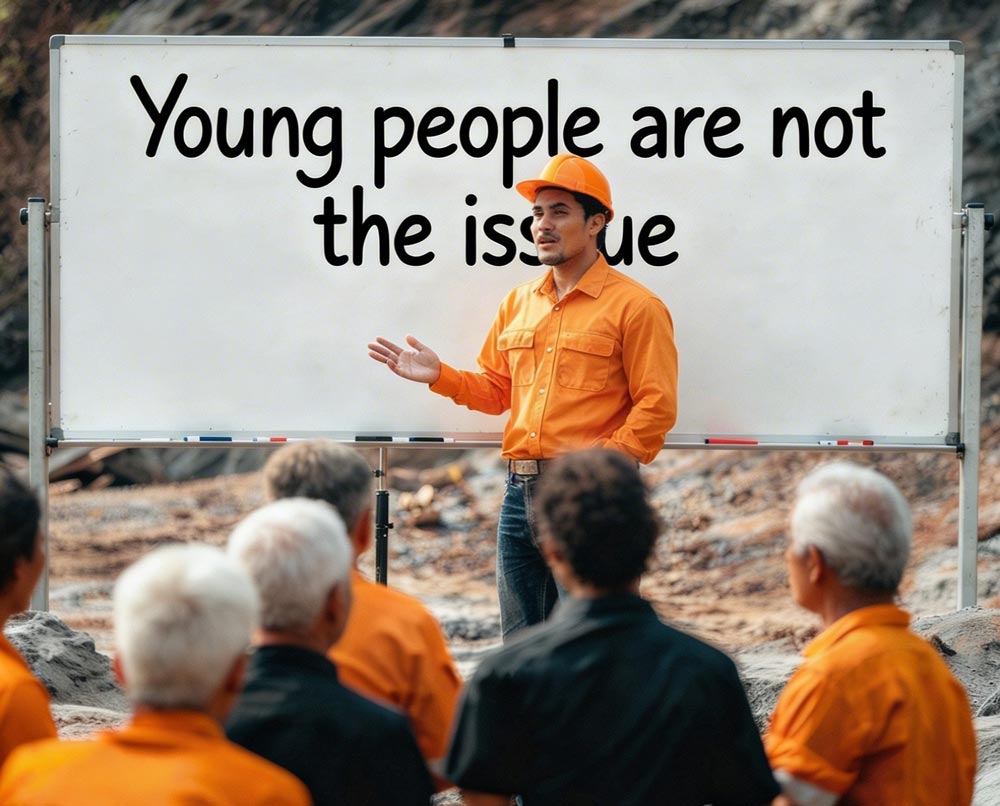
When you’re next holding a workplace drug and alcohol education session, try opening with a simple question: “Take a look around the room. Without naming names, who do you think is most likely to have an issue with drugs or alcohol?”
Most people will quietly make assumptions. Most will look at younger workers. They may picture them binge drinking with mates. Or taking ecstasy on a weekend dance party.
But here’s the reality: that assumption is often wrong.
In many cases, the person most at risk could be older, more experienced, and highly trusted. Someone in their 40s, 50s, or beyond. Someone who shows up every day and performs well. And there’s evidence to support it.
The Australian Institute of Health and Welfare (AIHW) has consistently shown that risky alcohol consumption occurs across all age groups, not just among younger people. In fact, middle-aged Australians often report drinking patterns that exceed recommended guidelines.
It’s the same with drugs, particularly prescription medication. Misuse often increases with age, which can introduce additional risks in the workplace.
The key message is simple: drug and alcohol risk does not discriminate by age, sex, role, or experience.
This is one of the most important truths to address in workplace drug and alcohol education.
Why the focus on young people persists
For years, public messaging around drugs and alcohol has focused heavily on young people. In some cases, there are good reasons. For example, younger people are more likely to experiment.
But this focus has created an unintended consequence. It has shaped how people think about risk. Many workers carry this belief into the workplace. They assume that risk declines with age. They assume experience leads to better decision-making. And this is not always the case.
Workplace drug and alcohol education must actively challenge this outdated thinking.
What the Australian data tells us
Australian data provides a clearer picture of how alcohol and drug use is spread across the population.
According to the AIHW’s National Drug Strategy Household Survey:
- People in their 40s and 50s are among the most likely to drink regularly
- Long-term risky drinking is common in middle-aged groups
- Older Australians are more likely to have issues with prescription medications
There is some truth to drug use being more of an issue for young people when it comes to illegal drugs. For example:
- 18–24 year olds have the highest rate of “recent use” of illegal drug use within the last year). Roughly 35% (over 1 in 3) of people in this bracket reported using an illicit drug recently.
- 20–29 year olds are the group mostly likely to use cocaine.
- Young women in the 18–24 age group are now just as likely as young men to use illicit drugs, closing a long-standing gender gap.
So why are older workers often overlooked in drug and alcohol conversations? Part of its due to a culture shift.
If we go back 50 years to the mid-1970s, the “drug and alcohol problem” in Australia looked very different. It was almost exclusively defined by young men and a heavy-drinking culture that was just starting to see the rise of recreational illicit drugs.
Today, while young people still experiment, which is why illegal drugs are still an issue within these age groups, the “risk profile” has changed significantly. This is particularly the case with alcohol:
- In the 1970s, heavy drinking was the social norm for young Australians. Today, we are seeing a “sober curious” generation amongst younger age groups. Meanwhile, older age groups have many “loyal drinkers” who have continued their drinking habits from their younger years.
- 50 years ago, binge drinking peaked in the late teens and early 20s. There was very little “abstinence” among youth; drinking was a rite of passage.
- Today, young people (18–24) are drinking less than previous generations. They are more likely to be teetotallers or “moderate” drinkers.
- The most consistent “daily” drinkers in Australia are now people over 70. While they don’t usually binge (drink 10+ in a night), they drink more frequently throughout the week than 20-year-olds.
Why this matters to workplace drug and alcohol education and to workplaces in general
50 years ago, a manager’s biggest worry was a young worker showing up drunk after a big night. Today, it’s just as likely to be the middle-aged person who’s misusing prescription painkillers or stimulants to keep up, deal with pain, or manage a long-term, hidden dependency.
50 years ago, the “drug problem” was something you expected a person to grow out of. Today, it’s increasingly something people are growing into or carrying with them for decades.
Of course, there’s also a risk that a workplace believes the ‘younger people are the issue’ myth. When workplaces assume that younger workers are the main risk group, they create blind spots. These blind spots can lead to:
- Missed warning signs
- Inconsistent messaging
- Uneven enforcement of policies
For example, a younger worker may be closely monitored and forced to undergo more ‘random’ workplace drug testing, while an older worker is given more trust and less scrutiny.
This not only creates imbalance and a lack of fairness. It could mean that some people with drug and alcohol issues are slipping under the carpet.
How to improve workplace drug and alcohol education
Given what you know now, make sure your workplace drug and alcohol education is relevant to all age groups. You might include real-world examples that reflect different life stages, discussions about alcohol use beyond social settings, information about prescription medication and its effects, encourage open conversations, reduce stigma around speaking up, and reinforce that risk is about behaviour, not age or sex.
The goal of workplace drug and alcohol education is not to single out any group. It is to create awareness across the entire workforce. When people understand that risk can apply to anyone, they are more likely to engage with the message.
FEATURED IMAGE CAPTION:
A workplace drug and alcohol education session is held in a mining environment.